
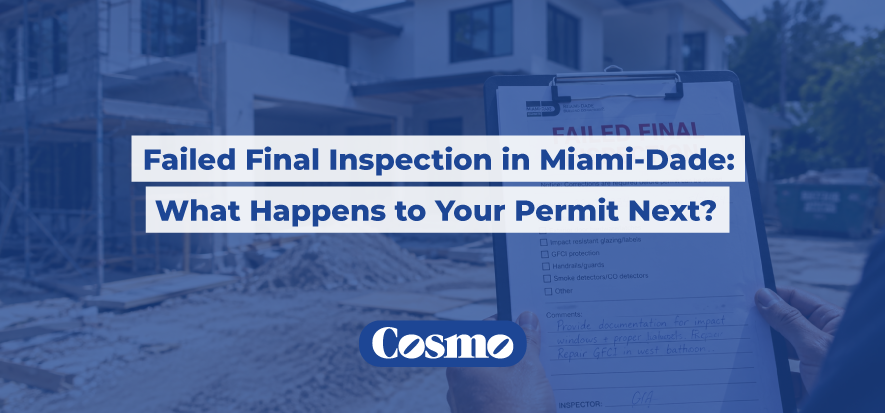
Failed Final Inspection in Miami-Dade: What Happens to Your Permit Next?
Reaching the final inspection should mean your construction project is almost finished. Unfortunately, many Miami-Dade property owners discover that completing the work does not automatically mean the permit is ready to close. If the inspector finds an unresolved code issue, incomplete work, missing documentation, or a discrepancy with the approved plans, the final inspection can fail and the permit remains open.
A Miami Dade failed final inspection permit should be addressed quickly. A failed inspection is usually fixable, but ignoring the result can create a much more complicated permitting problem. Miami-Dade County states that permits can expire when permitted work does not begin or an approved inspection does not occur within the applicable 180 day period. This makes the word “approved” particularly important. A failed final inspection should not be treated as an approval that protects the permit indefinitely. Miami-Dade County provides additional information about permit time limits here.
What Does a Failed Final Inspection Mean in Miami-Dade?
A failed final inspection means the inspector has determined that the project is not yet ready for final approval. It does not necessarily mean the entire project must be redone, and it does not automatically become a code violation the moment the inspection fails. It does mean that the permit has not been successfully finalized.
Miami-Dade requires inspections throughout permitted construction to verify compliance with applicable codes and approved plans. Once the work is complete and required trade inspections have been approved, the project may require final building approval before the permit can be closed. Approved plans and the permit card must also be available for inspections. Miami-Dade explains its inspection requirements and scheduling procedures on its official inspection page.
This is why owners should never assume that paying the contractor or finishing construction means the permit is closed. If you are unfamiliar with the overall permitting process, our guide to Miami-Dade building permits explains how permits move from application through inspections and completion.
Why Do Final Inspections Fail?
Final inspections can fail for reasons ranging from relatively simple corrections to issues requiring additional professional involvement. The inspector may identify work that does not match the approved plans, unfinished elements, missing required inspections from another trade, inaccessible areas, missing documentation, unresolved permit holds, or conditions that do not comply with applicable code requirements.
Sometimes the construction itself is acceptable but the permit history is incomplete. A project involving electrical, plumbing, mechanical, roofing, structural, zoning, or other disciplines can involve multiple inspections, and one unresolved component may prevent final closure.
These problems become particularly frustrating when a property owner believes the project was completed months earlier. Our article about permit mistakes that stall Miami construction projects explains why administrative details can become just as important as the physical work itself.
What Happens to Your Permit After the Final Inspection Fails?
The permit generally remains open while the outstanding issue is corrected. The next objective should be identifying exactly why the inspection failed, determining what must be corrected, completing that work, and scheduling the appropriate reinspection.
Property owners can review building permit and inspection history through Miami-Dade’s online records systems using information such as the permit number, process number, or property address. Miami-Dade provides free access to building permit and inspection history online.
Do not rely only on what a contractor verbally says about the inspection. Verify the recorded result and determine whether other required inspections, subsidiary permits, fees, or holds remain outstanding.
Miami-Dade also notes that an inspection cannot be requested when reinspection fees are owed or when an inspection hold exists on the permit. Additional inspections beyond those covered by the permit may generate additional fees.
If the permitting record is confusing or several contractors and disciplines are involved, this is where professional permit coordination can save significant time. Cosmo Management Group can help property owners organize the permit history, identify unresolved items, coordinate the parties involved, and keep the process moving toward final closure instead of allowing a manageable failed inspection to become a long term open permit problem.
The 180 Day Problem You Should Not Ignore
One of the biggest mistakes after a failed final inspection is assuming there is unlimited time to make corrections.
Miami-Dade states that a permit can expire if permitted work does not start or an approved inspection does not occur within the applicable 180 day timeframe. An additional 180 day extension may be available through the permitting process.
The important distinction is that your final inspection failed. You should not assume that the unsuccessful inspection automatically gives you another 180 days.
If the expiration date is approaching, investigate the permit immediately instead of waiting until the repairs are convenient. Permit extensions and permit reissues are different procedures, and the appropriate option depends on the permit’s current status.
Miami-Dade describes a permit reissue as the process used to renew or reopen a permit that expired without a final inspection. After reissuance, the County provides 180 days to close the permit, and closure occurs when the final inspection demonstrates that all permit requirements have been satisfied. The County’s permit extension and reissue requirements are available here.
If your permit has already been sitting unresolved, read how to close an open building permit in Miami-Dade before it becomes a bigger property problem.
Do You Need a Revision Before Scheduling Another Inspection?
Not every failed final requires a permit revision. If the inspector simply requests correction of workmanship or completion of an approved item, correcting the deficiency and arranging a reinspection may be enough.
The situation changes when the completed construction differs from the approved plans. Miami-Dade allows permit revisions before final inspection, but revisions go through an approval process and do not extend the expiration date of the original permit.
That means submitting a revision should not create a false sense that the permit clock has stopped. Owners should coordinate corrections, design professionals, contractors, revisions, inspection requirements, and permit deadlines as one process.
This is especially important when previous owners or contractors performed work differently from what appears in County records. Before assuming the permit history is clean, property owners can review our guide to conducting a Miami-Dade property permit and violation search.
What Happens If You Leave the Failed Inspection Unresolved?
The immediate consequence is simple: the permit remains unfinished. The longer term consequences can be much less convenient.
Miami-Dade identifies expired permits as building code violations when authorized work has not been completed, inspected, and closed within the required timeframe. Failure to correct violations can eventually lead to enforcement actions that may include notices, fines, liens, and legal proceedings depending on the circumstances.
An unresolved permit can also surface when a property is refinanced, insured, renovated, or prepared for sale. A problem that could have been corrected shortly after the failed inspection may become much harder years later when the original contractor is unavailable and documentation is difficult to locate.
If you are already preparing a transaction, see Buying in Miami-Dade? Check Open Permits Before Your Dream Property Becomes Someone Else’s Problem.
Final Approval Is What Actually Matters
For projects requiring a Certificate of Occupancy or Certificate of Completion, construction being physically finished is not enough. Miami-Dade states that approved inspections and applicable completion holds must be satisfied before the appropriate certificate can be issued. The County explains Certificate of Occupancy and Certificate of Completion requirements here.
Your real finish line is therefore not the day the contractor leaves the property. It is the day the permit record shows that the required final approvals have been completed.
There is also an important jurisdiction issue. Miami-Dade County contains 35 municipalities, each with its own building official responsible for permitting and inspections within that jurisdiction. Properties in unincorporated Miami-Dade are generally handled by the County, while properties inside incorporated cities may need to work with the applicable municipal building department. Miami-Dade provides a jurisdiction and municipal permitting overview here.
Turn a Failed Inspection Into a Closed Permit
A failed final inspection is not the end of your project, but it should never be ignored. Confirm the recorded inspection result, identify every outstanding correction, check the permit expiration status, resolve applicable fees or holds, determine whether revisions are necessary, and arrange the required reinspection as quickly as practical.
The sooner the permitting record is organized, the easier it usually is to resolve the problem before contractors disappear, records become harder to find, or the permit moves into expired status.
If your Miami Dade failed final inspection permit is still open and you are unsure what needs to happen next, Cosmo Management Group can help coordinate the process from the failed inspection through permit closure. Instead of spending weeks navigating inspection records, contractors, correction requirements, permit deadlines, and County procedures on your own, work with a team familiar with Miami-Dade permit and compliance issues.
Connect with Cosmo Management Group today and take action before a failed final inspection becomes an expired permit, a code compliance problem, or an obstacle when you need to sell or refinance your property.
Frequently Asked Questions About Failed Final Inspections in Miami-Dade
What happens after a failed final inspection in Miami-Dade?
After a failed final inspection, the permit generally remains open because final approval has not been obtained. The property owner or contractor should review the inspection result, correct the cited deficiencies, resolve outstanding permit requirements, and schedule the appropriate reinspection.
Does a failed inspection extend a Miami-Dade building permit?
You should not assume that it does. Miami-Dade bases permit expiration on obtaining an approved inspection within the applicable timeframe. Because a failed inspection is not an approved inspection, owners should verify the permit expiration date immediately rather than assuming the failed inspection restarted the permit timeline.
Can a Miami-Dade permit expire after failing the final inspection?
Yes. A permit that remains unresolved and does not receive the required approved inspection can eventually expire. Miami-Dade considers expired permits a code compliance issue, which is why correcting a failed final inspection promptly is important.
How do I check the results of a Miami-Dade permit inspection?
Miami-Dade provides online building permit records that allow owners to review permit and inspection history using a permit number, process number, or property address. Checking the official record is preferable to relying exclusively on information from a contractor.
Do I have to pay a reinspection fee after a failed inspection in Miami-Dade?
Additional inspection fees may apply depending on the permit and the number of inspections already performed. Miami-Dade also states that an inspection request cannot be processed when applicable reinspection fees remain unpaid.
What happens if my Miami-Dade permit expires before I pass final inspection?
Depending on the permit’s status and timing, you may need a permit extension or permit reissue. Miami-Dade describes reissue as the process of reopening a permit that expired without final inspection and provides a new period in which the permit must be closed.
Can I sell a property with a failed final inspection and an open permit in Miami-Dade?
An open permit does not automatically mean every transaction is impossible, but unresolved permits can create complications during due diligence, financing, title review, renovations, and negotiations. Property owners planning a sale should determine the exact permit status and, when possible, resolve the outstanding inspection before closing.
Can Cosmo Management Group help resolve a failed final inspection permit?
Cosmo Management Group can assist property owners with permit coordination, inspection follow up, documentation, contractor communication, and the steps required to move unresolved permit matters toward closure. This can be especially valuable when the original project involved multiple trades, older permits, missing records, or a permit approaching expiration.


0 comments