
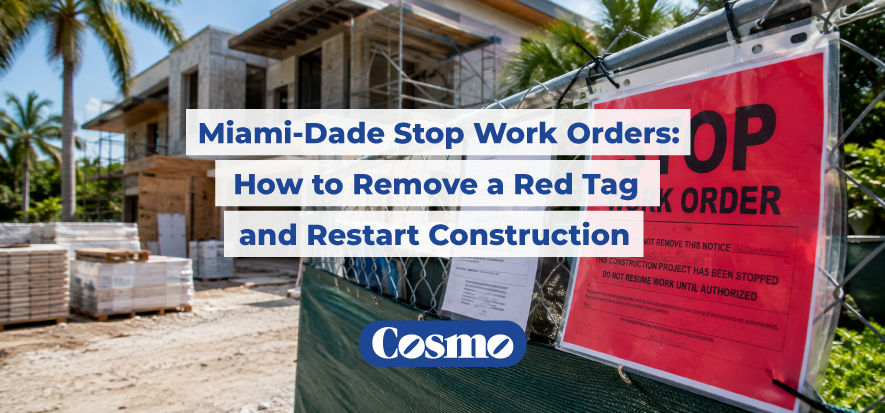
Miami-Dade Stop Work Orders: How to Remove a Red Tag and Restart Construction
A red tag appearing on a Miami-Dade construction project can turn an ordinary renovation into an immediate financial and legal problem. Contractors may have to leave the site, scheduled work stops, materials sit unused, and every additional day can increase labor, carrying, and financing costs. If you are dealing with a Miami Dade stop work order permit issue, the most important thing to understand is that simply correcting the visible problem does not automatically authorize construction to restart.
Under Miami-Dade County regulations, the Building Official may stop construction when work is being performed contrary to applicable requirements or in an unsafe or dangerous manner. Once a stop work order has been issued, the affected work must remain stopped until arrangements that satisfy the Building Official have been made and authorization to proceed has been given.
That makes the first hours after receiving a red tag critical.
What Does a Miami-Dade Stop Work Order Mean?
A stop work order is an official directive requiring construction activity to cease. Owners sometimes refer to the notice posted at the property as a red tag, but the real issue is the enforcement action behind that notice.
A project may be stopped because work began without the required permit, construction differs from approved plans, required inspections were skipped, an existing permit expired, unauthorized electrical, plumbing, mechanical or structural work was discovered, or an inspector identified an unsafe condition.
Miami-Dade specifically identifies construction without permits, expired permits and unsafe structures as common building code enforcement issues. Failure to correct violations can escalate into civil fines, liens and additional enforcement proceedings.
Property owners dealing with unpermitted construction should also review What Really Happens If You Build Without a Permit in Miami? because a stop work order is often only one part of a larger compliance problem.
First, Stop the Work
Continuing construction after receiving an order is one of the worst decisions an owner or contractor can make.
Do not assume that finishing one small portion of the project will make the situation easier to resolve. Do not cover walls, conceal electrical or plumbing work, remove the posted notice, or continue because a contractor believes the violation is minor.
Miami-Dade’s code gives the Building Official authority to require work to stop immediately. It also allows portions of concealed construction to be exposed when officials have reason to believe unsafe work or a violation has been hidden.
Continuing work can therefore transform a manageable permitting problem into a more complicated enforcement case.
Determine Who Issued the Stop Work Order
Before submitting applications or paying fees, identify the authority that issued the order.
Miami-Dade County’s permitting process applies to properties within its permitting jurisdiction, including properties in unincorporated Miami-Dade County. Properties inside municipalities such as Miami, Miami Beach, Coral Gables or other incorporated cities generally have their own Building Official and permitting department.
Miami-Dade states that its County permitting process applies to properties with folio numbers beginning with 30 and directs owners of properties within municipalities to the appropriate municipal building authority.
This distinction matters. Filing documents with the wrong agency wastes time while the construction site remains inactive.
Owners can use Miami-Dade’s Building Support Case Search and other online compliance resources to research applicable enforcement cases, permit information and certain violations.
Find Out Exactly Why Construction Was Stopped
The red tag is not something you solve by simply requesting another inspection. You first need to determine the underlying violation and what the Building Official requires before work can legally resume.
For example, if the project was stopped because construction began without permits, the owner may need to obtain the appropriate building permit and submit plans documenting existing or proposed work. If the work differs from approved drawings, revised plans may be necessary. If required inspections were missed, portions of completed work may need to remain accessible or even be opened for inspection.
If you are unfamiliar with Miami-Dade’s permitting system, Miami-Dade Building Permits: Step-by-Step Guide, Costs & Common Mistakes explains the broader permitting process, while The Costly Permit Mistakes That Stall Miami Construction Projects covers common errors that can delay projects.
This is where experienced permit and violation coordination can save substantial time. Instead of moving between contractors, inspectors and departments without a clear strategy, Cosmo Management Group can help property owners understand the compliance path, coordinate the required documentation and keep the resolution process moving toward reopening the project.
Do You Need a New Permit to Remove a Red Tag?
Often, but not always.
If work requiring a permit was performed without one, obtaining the proper permit is typically part of bringing the property back into compliance. Miami-Dade explains that resolving building violations may involve obtaining permits, completing corrective work, scheduling required inspections and addressing unsafe conditions.
The County’s current permitting process allows applications and supporting documents to be submitted electronically. Depending on the project, plans may undergo review for compliance with the Florida Building Code, Miami-Dade requirements and other applicable regulations. As of August 2026, Florida continues to operate under the 8th Edition, 2023 Florida Building Code, which became effective December 31, 2023.
If the problem involves previously completed unpermitted work rather than an active project, read Built Without a Permit in Miami? Here’s Exactly How to Fix It Before It Costs You the Deal.
A Major 2026 Change Property Owners Should Know
Florida permitting rules changed on July 1, 2026, and some Miami-Dade residential projects may now qualify for a permit exemption.
Miami-Dade explains that certain work valued under $7,500 on qualifying single family homes, duplexes and townhouses may fall under the new exemption rules. However, major limitations apply. Electrical, plumbing, structural, mechanical and gas work still requires permits, and projects cannot simply be divided into smaller portions to avoid permitting requirements. Properties in certain flood hazard areas are also excluded from the new exemption.
Therefore, receiving a red tag does not mean you should immediately assume that the work is now exempt. The scope, property type, location and nature of the construction must be reviewed against the current rules.
Correct the Violation and Complete the Required Inspections
Once the appropriate permit, revised plans or corrective work has been approved, the next step usually involves inspections.
Miami-Dade requires inspections for construction, renovations and applicable electrical, plumbing and mechanical work. Work must remain accessible before it is covered, which is particularly important when a stop work order involves construction completed before proper inspections occurred.
Inspection failures should be corrected precisely rather than treated as a trial and error process. If one discipline requires additional work, resolve those comments before requesting another inspection whenever possible.
If an expired or unresolved permit is part of the problem, Don’t Let an Old Permit Kill Your Deal: How to Close an Open Building Permit in Miami-Dade Before It Becomes a Lien provides additional guidance.
When Can Construction Legally Restart?
Construction should restart only after the authority that issued the stop work order has determined that the required compliance arrangements have been satisfied and the affected work has been authorized to continue.
A contractor saying the issue has been corrected is not enough. A permit application being submitted is not enough. Paying a fee is not necessarily enough either.
The objective is not merely to remove a physical red notice from the property. The objective is to resolve the underlying Miami Dade stop work order permit problem in the official record and obtain authorization to proceed.
This distinction can prevent an owner from accidentally violating the same order twice.
Do Not Let a Stop Work Order Become a Larger Property Problem
Stop work orders can affect much more than the construction schedule. An unresolved permit or violation can later surface during refinancing, insurance reviews, property management transitions or a future sale. Miami-Dade provides public tools for researching permit histories, work without permit violations, expired permits and recorded liens associated with properties.
If you have already received an enforcement notice, Just Received a Notice of Violation in Miami-Dade? Read This Before It Costs You Thousands explains why delaying corrective action can make the situation considerably harder to manage.
Get Your Miami-Dade Construction Project Moving Again
A stop work order does not necessarily mean your project is permanently derailed, but it does mean construction should not continue until the compliance issue is properly resolved.
The fastest path is usually to identify the issuing jurisdiction, understand the exact violation, determine which permits or revisions are required, coordinate contractors and professionals when necessary, complete the required inspections and confirm that the Building Official has authorized work to resume.
If your property has been red tagged and you are struggling to determine what Miami-Dade requires next, Cosmo Management Group can help coordinate the permitting and violation resolution process from the initial case review through the steps needed to move the project back toward compliance. Instead of losing additional weeks navigating departments, contractors, plans and inspections on your own, contact Cosmo Management Group and get a clear strategy for resolving the stop work order and restarting construction legally.
Frequently Asked Questions About Miami-Dade Stop Work Orders
How do I remove a stop work order in Miami-Dade?
You must first determine why the order was issued and satisfy the requirements established by the responsible Building Official. Depending on the case, this may require obtaining a permit, submitting corrected or revised plans, correcting unsafe or unauthorized work and completing inspections. Construction should not resume until the responsible authority authorizes it.
Can I continue construction after receiving a red tag in Miami-Dade?
No. If the posted notice constitutes a stop work order covering the construction being performed, the affected work must stop. Miami-Dade’s code provides that work subject to a stop work order must remain stopped until compliant arrangements satisfactory to the Building Official have been made.
What causes a Miami Dade stop work order permit violation?
Common causes include work without the required permit, construction that does not match approved plans, unsafe work, missed inspections, expired permits and unauthorized structural, electrical, plumbing or mechanical alterations.
How long does it take to remove a red tag in Miami-Dade?
There is no universal timeframe. Miami-Dade states that resolution time varies according to the type of violation, complexity of the corrective work and whether permits are required. Straightforward cases may be resolved relatively quickly, while projects requiring plans, engineering, multiple disciplines or significant corrections can take considerably longer.
Can I get a permit after construction has already started in Miami-Dade?
In many cases, permitting is part of the process required to legalize work that began without authorization. However, previously completed construction may need to be documented, exposed for inspection or modified to meet applicable requirements before the case can be resolved.
Does the new $7,500 permit exemption remove a Miami-Dade stop work order?
Not automatically. Beginning July 1, 2026, qualifying residential work under $7,500 may be exempt from certain permitting requirements, but numerous restrictions apply. Electrical, plumbing, structural, mechanical and gas work remain subject to permits, and property location and project scope can affect eligibility. An existing stop work order should be reviewed with the issuing authority rather than assuming the exemption cancels it.
Who removes a red tag in Miami-Dade County?
The issue must be resolved through the governmental authority responsible for the enforcement action. For properties under Miami-Dade County jurisdiction, that may involve the County Building Department or Building Enforcement. Properties inside incorporated municipalities may need to work with that city’s Building Official instead.
Can a stop work order create a lien on my Miami-Dade property?
An unresolved building violation can lead to escalating enforcement consequences. Miami-Dade states that failure to correct violations may result in civil fines, recorded liens and potential legal proceedings, which is why addressing the underlying permit or code problem promptly is important.


0 comments